Solid shapes
This lesson helps your child name the solid shapes in the cupboard, build with them, and find the flat shapes on their faces.
How it works
- Read the card. Your child builds, rolls and stacks the shapes as it says.
- Ask which faces are flat and what shape they are. Tap Show answer to check, then tap Next.
- When you are done, your child colours in stop 44 on the poster.
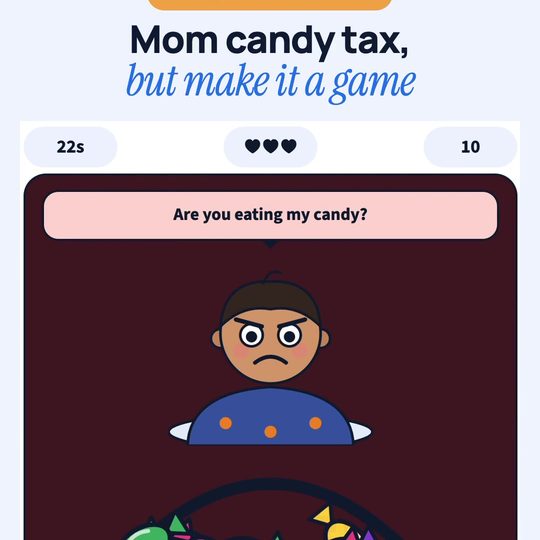
The game: Box tower
Get: A cereal box, a tin, a ball, a dice, and whatever else is in the cupboard.
- Open Box tower. Read the card: Find a box. Stand it up. Put a tin on top. Does it balance? Ask: Which faces are flat?
- Say: Try to stack the ball on the box. It rolls off. Ask: Why? No flat face. Roll the tin, then stand it up.
- Say: Build the tallest tower you can. Then ask what went at the bottom and why.
- Open Name it. Say: Name it. Does it roll? Does it stack? Tap Show answer. Then open Faces.
- Finish with a Why card, then your child colours in stop 44 on the poster.
How to play
Done? Colour in stop 44.
The journey poster is one page for the fridge. Print it once, and your child colours in a stop after each game.
More helpIf your child is stuck, or you want to see questions other parents ask, expand this list.
If your child is stuck
Your child calls the tin a circle
Say: the end is a circle. The whole thing is a cylinder. Flat shapes are on the faces; the solid is the whole thing you can hold.
Your child cannot say why the ball rolls off
Put the ball on the table and push it. Then the box. Say: the box has a flat face to sit on. Feel the ball. Any flat bit? No.
Cube and box get mixed up
Hold a dice and a cereal box. Say: the dice faces are all squares, all the same. That is a cube. The box faces are rectangles. That is a rectangular prism, or just a box.
Questions parents ask
Do I have to say rectangular prism?
Box is fine at home. Ontario Grade 1 asks children to sort and build with solids and find the flat shapes on them, not to recite names. Say the proper name once and let your child use whichever.
What about a pyramid?
It is on the cards because children love it. In the house it is rare. Egypt and a pointed roof are the examples.
Does my child have to touch the screen?
No. You hold the phone and tap. Your child counts, moves things, steps or shows fingers, and tells you the answer.
Why does this matter?
Solid shapes are the kitchen cupboard, and Ontario Grade 1 asks children to sort them by one attribute, build with them, and find the flat shapes inside them. A tower that falls over because a ball has no flat face teaches more than a diagram.
Which cards are in this lesson?
Box tower (8 cards). Say: Find a box. Stand it up. Put a tin on top. Does it balance? Say: Try to stack a ball on the box. What happens? Say: Roll the tin along the table. Now stand it up. Can it roll now? Say: Find a dice or a cube. Count its faces. Say: Look at a cereal box. What shape are the faces? Say: Find a cone: an ice cream cone, a party hat, a funnel. What flat shape is at the bottom? Say: Build the tallest tower you can from boxes and tins. Which shapes went where? Say: Sort the shapes: ones that roll and ones that do not. Name it (10 cards). a cube, a cube, a sphere, a rectangular prism, a pyramid, a sphere, a cone, a cylinder. Faces (8 cards). Which solid has six square faces? Which solid has no flat faces at all? What flat shape is on the end of a tin? Which solid is like a cereal box? Which rolls and also stacks? Which would you put at the bottom of a tower? Why (3 cards). Why does a ball roll off the tower? How do you know a box is a rectangular prism? Which shapes make a strong tower?
How does this lesson fit the Ontario curriculum?
It supports the Ontario Mathematics curriculum, Grade 1 (2020). Specific expectations: E1.1 Sort flat shapes and solid objects by one attribute and say the rule; E1.2 Build solids and find the flat shapes in objects.